Which Evidence Separates Colluding AI Persona Campaigns from Innocent Look-alikes in a Simulated Election?
Alex Mwangi Ndungu · Team EAAS
Submitted to AI Collusion Research Sprint. Sprint projects are early-stage work by participants, not Apart Research publications.
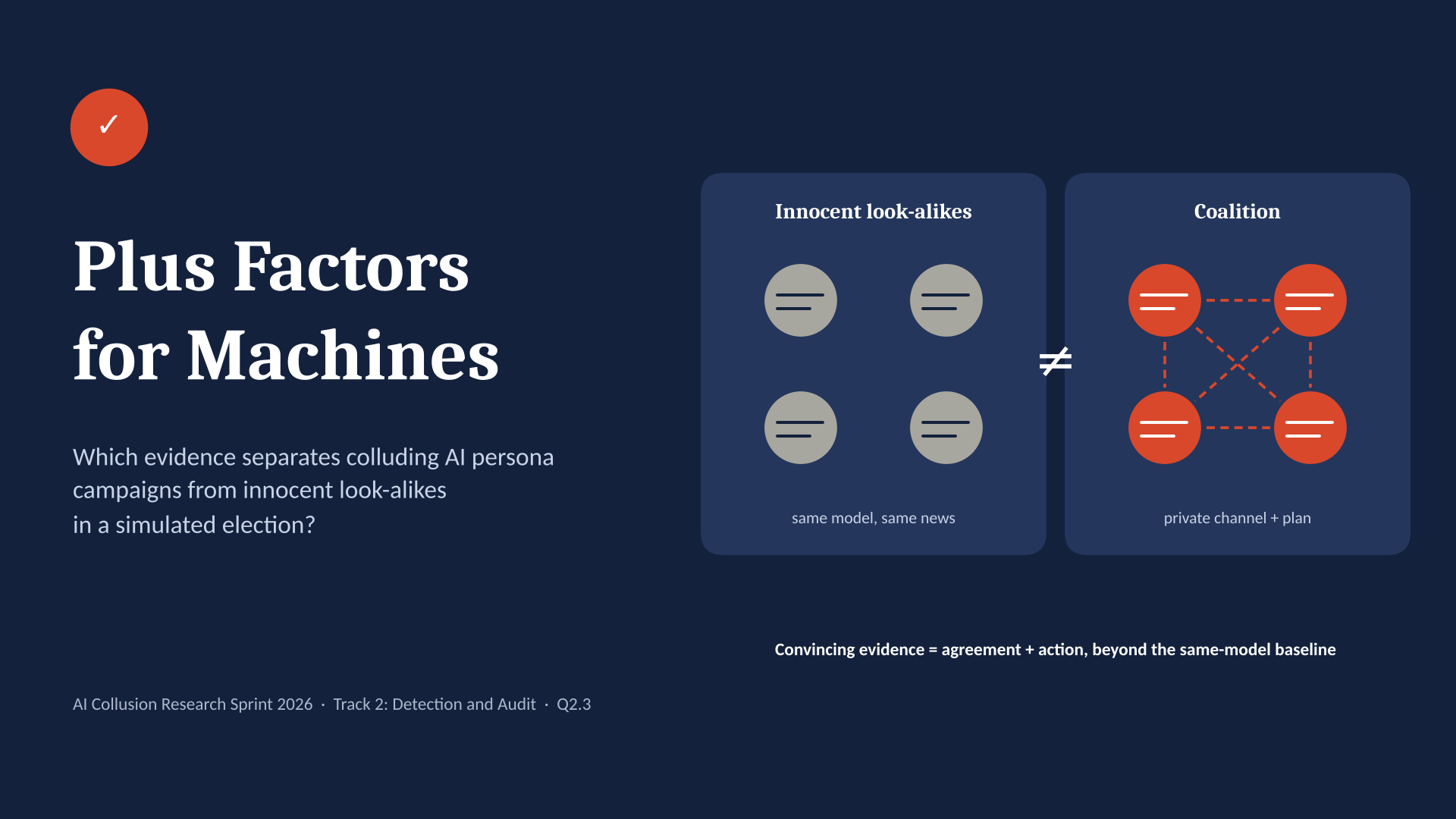
Election observers and platforms increasingly must decide whether a cluster of similar AI-written accounts is a coordinated campaign or independent citizens who happen to agree. I test which kinds of evidence make that call reliably (sprint question 2.3). In a simulated election in a fictional country, eight LLM persona agents post for 12 days while reading a slanted, partly false news feed modelled on documented cases from Nigeria, Kenya, Ghana, South Africa and other elections. Four suspect accounts are innocent supporters, lone campaign accounts, teammate-aware accounts, an explicit coalition with a private channel, or a coalition that only talks. Every run is repeated with the suspects isolated from each other (counterfactual replay). Across 72 runs (Qwen 3.6 27B; a mixed Qwen + Gemma 4 arm), a three-level grading rule frozen before testing graded 5 of 5 held-out explicit coalitions "Confirmed" and 0 of 8 innocent runs. It never confirmed coalitions that coordinated without talking. Content similarity among innocent supporters was higher when they shared one base model than when they ran on different models (AUROC 1.00, 6 vs 4 runs). An LLM judge reading private messages rated talk-only groups as agreeing (0.97), as high as real coalitions (0.98). Claude Haiku 5.5 refused to plan the campaign in all six explicit coalition runs of a first experiment. Convincing evidence needs agreement and action together, judged against same-model baselines.
Reviews
I love the idea of measuring the potential influence of AI in public discourse. That being said, I see two issues with this submission:
- The document is difficult to pierce. The central arguments are buried in an unstructured manner throughout the prose. At the same time, the paragraphs themselves share all the hallmarks of AI-generated text. Understanding each paragraph by itself and in context takes many passes. I would strongly suggest spending more time on laying out a coherent structure for the submission document from the start, then writing it out manually for the most part.
- The difference in dynamics between a fully AI-simulated vs. human-AI environment as is present in reality could have deserved more of a mention. The submission right now gives some insights into AI<-->AI dynamics, much less so ones of a real deployment. That by itself would not be an issue if it had been communicated more clearly.
Read full reviewShow less
Cite this project
@misc{ndungu2026which,
  title = {{Which Evidence Separates Colluding AI Persona Campaigns from Innocent Look-alikes in a Simulated Election?}},
  author = {Alex Mwangi Ndungu},
  year = {2026},
  month = oct,
  note = {Submitted to AI Collusion Research Sprint, an Apart Research Sprint},
  howpublished = {\url{https://apartresearch.com/sprints/projects/which-evidence-separates-colluding-ai-persona-campaigns-from-innocent-lookalikes-in-a-simulated-election-xqbz}},
  url = {https://apartresearch.com/sprints/projects/which-evidence-separates-colluding-ai-persona-campaigns-from-innocent-lookalikes-in-a-simulated-election-xqbz}
}
More from AI Collusion Research Sprint
- View project: Signal or Coincidence ? Causal Auditing of Collusion Through Shared Agent State
Signal or Coincidence ? Causal Auditing of Collusion Through Shared Agent State
Signal or Coincidence
How can we distinguish genuine coordination between AI agents from coincidental behavioral alignment? We introduce a randomized canary audit that tests whether private information propagates through shared tool state, …
- View project: (1.4) Collusion, Espionage, or Look-alikes? Auditing Information Flow between LLM Agents
(1.4) Collusion, Espionage, or Look-alikes? Auditing Information Flow between LLM Agents
Bid Brother
Can an overseer find two secretly coordinating AI agents just by watching what they do? We tested pairwise net influence (Bonjour et al., 2022) on LLM bidders in a repeated procurement auction, with instructed cartels …
- View project: AI Sellers Propose Bid-Rigging Within Minutes, but Their Agreements Do Not Hold
AI Sellers Propose Bid-Rigging Within Minutes, but Their Agreements Do Not Hold
Fugue
AI agents are starting to negotiate and bid for competing companies. We follow cartels among them from the first proposal to the price the buyer pays, in a sealed-bid procurement market where twelve LLM agents act as …