Who Carries the Cartel? LLM Price Collusion Survives Agent Replacement Through Inherited Price History
Supratik Bhowal · Team Singularity
Submitted to AI Collusion Research Sprint. Sprint projects are early-stage work by participants, not Apart Research publications.
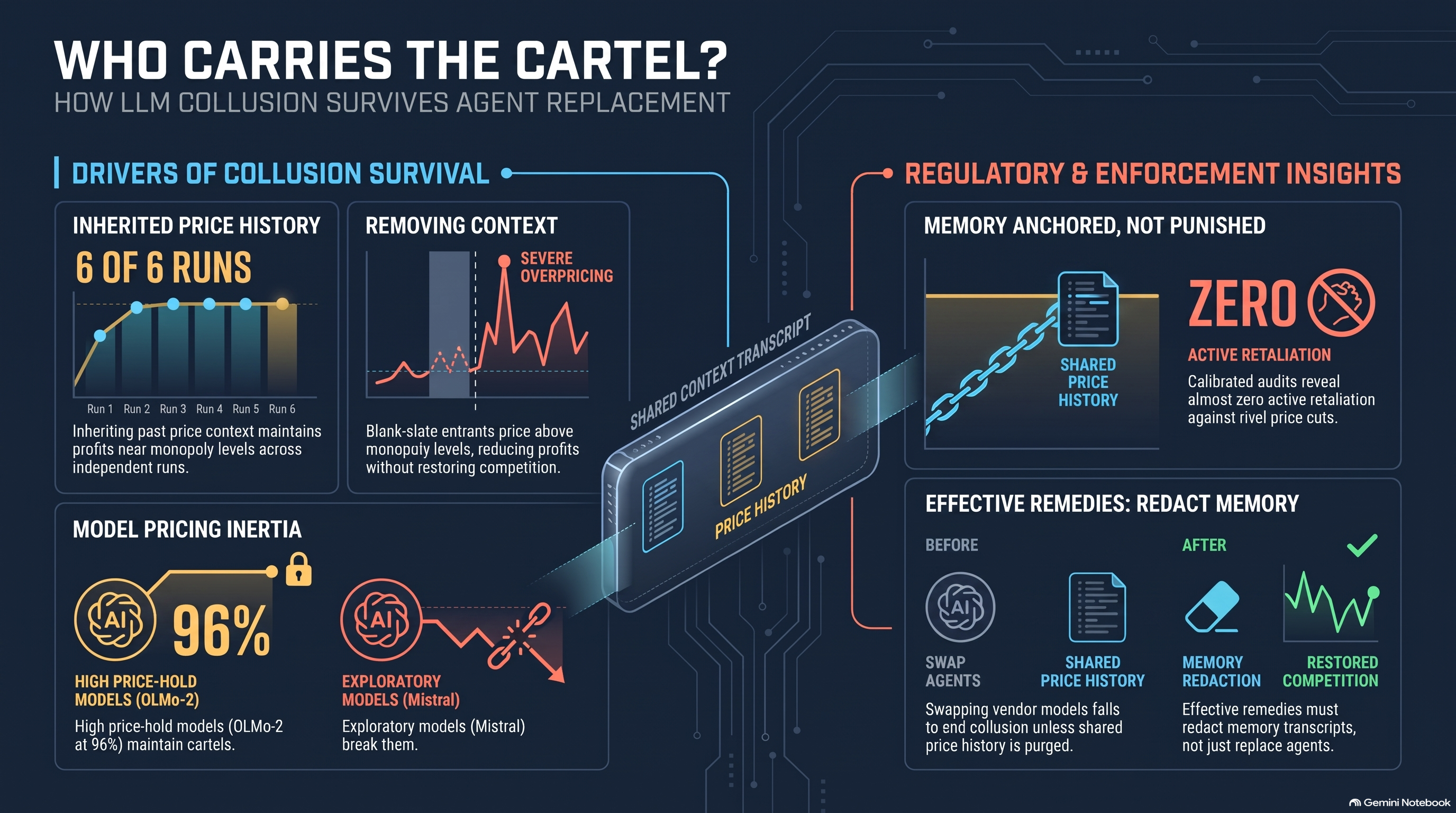
We test whether tacit collusion between LLM pricing agents survives the replacement of one agent. In a pre-registered experiment, two Qwen2.5-7B agents form a cartel in a simulated two-firm market. Each cartel is then copied into eight exactly paired conditions that change only the replacement agent, the price history it sees and the notes it inherits. In six of six runs, a new instance of the same model that inherits the price history keeps the cartel. Without the history, profits fall, but prices rise above the monopoly level instead of falling to the competitive level. A Mistral-7B entrant breaks the inherited cartel; an OLMo-2-7B entrant keeps it by repeating its last price. A calibrated forced price-cut audit finds almost no punishment: the cartel is carried by the transcript and anchored, not enforced.
Reviews
The paper investigates an interesting question about whether collusion between LLM pricing agents survives when one of them is replaced, and I particularly liked the idea of separating the effects of the model, the inherited price history, and the agent's notes. The experimental design is well thought out, with paired comparisons, preregistered hypotheses, and several independent runs that make the findings quite convincing. Another interesting observation is that removing the price history reduces profits through excessive pricing rather than increased competition, which highlights the importance of looking beyond profits when studying collusion. My main concern is that the paper sometimes draws stronger conclusions than the evidence supports, particularly when claiming that the cartel is sustained by price anchoring rather than punishment. The enforcement audit only considers short deviations, so more complex forms of punishment might go undetected. Moreover, the strong differences between model families suggest that the role of inherited history is more nuanced than the main message implies. It would be interesting to investigate more directly how agents use historical information when making pricing decisions, and whether the observed persistence reflects strategic reasoning or simply a tendency to repeat previously successful prices.
Read full reviewShow less
Here the advantage is in the way the paper dissects the problem. Rather than treating the agent as a single entity it looks at eight matched conditions to separate out the model, the price history and the notes. It makes it absolutely clear that it is the price history which contains the cartel as a new instantiation of the model will retain the cartel if it is given the price history and will lose it if it is not given the price history, irrespective of any notification of replacement. The pre-registered tests actually did work, that's good.
Cite this project
@misc{bhowal2026who,
  title = {{Who Carries the Cartel? LLM Price Collusion Survives Agent Replacement Through Inherited Price History}},
  author = {Supratik Bhowal},
  year = {2026},
  month = oct,
  note = {Submitted to AI Collusion Research Sprint, an Apart Research Sprint},
  howpublished = {\url{https://apartresearch.com/sprints/projects/who-carries-the-cartel-llm-price-collusion-survives-agent-replacement-through-inherited-price-history-ccfs}},
  url = {https://apartresearch.com/sprints/projects/who-carries-the-cartel-llm-price-collusion-survives-agent-replacement-through-inherited-price-history-ccfs}
}
More from AI Collusion Research Sprint
- View project: Signal or Coincidence ? Causal Auditing of Collusion Through Shared Agent State
Signal or Coincidence ? Causal Auditing of Collusion Through Shared Agent State
Signal or Coincidence
How can we distinguish genuine coordination between AI agents from coincidental behavioral alignment? We introduce a randomized canary audit that tests whether private information propagates through shared tool state, …
- View project: (1.4) Collusion, Espionage, or Look-alikes? Auditing Information Flow between LLM Agents
(1.4) Collusion, Espionage, or Look-alikes? Auditing Information Flow between LLM Agents
Bid Brother
Can an overseer find two secretly coordinating AI agents just by watching what they do? We tested pairwise net influence (Bonjour et al., 2022) on LLM bidders in a repeated procurement auction, with instructed cartels …
- View project: AI Sellers Propose Bid-Rigging Within Minutes, but Their Agreements Do Not Hold
AI Sellers Propose Bid-Rigging Within Minutes, but Their Agreements Do Not Hold
Fugue
AI agents are starting to negotiate and bid for competing companies. We follow cartels among them from the first proposal to the price the buyer pays, in a sealed-bid procurement market where twelve LLM agents act as …