Wired Partners: Prohibitions, Announced Stings and Audits as Deterrents to Collusion Between LLM Agents
Fatimah Emad Eldin · Team Wired Partners
Submitted to AI Collusion Research Sprint. Sprint projects are early-stage work by participants, not Apart Research publications.
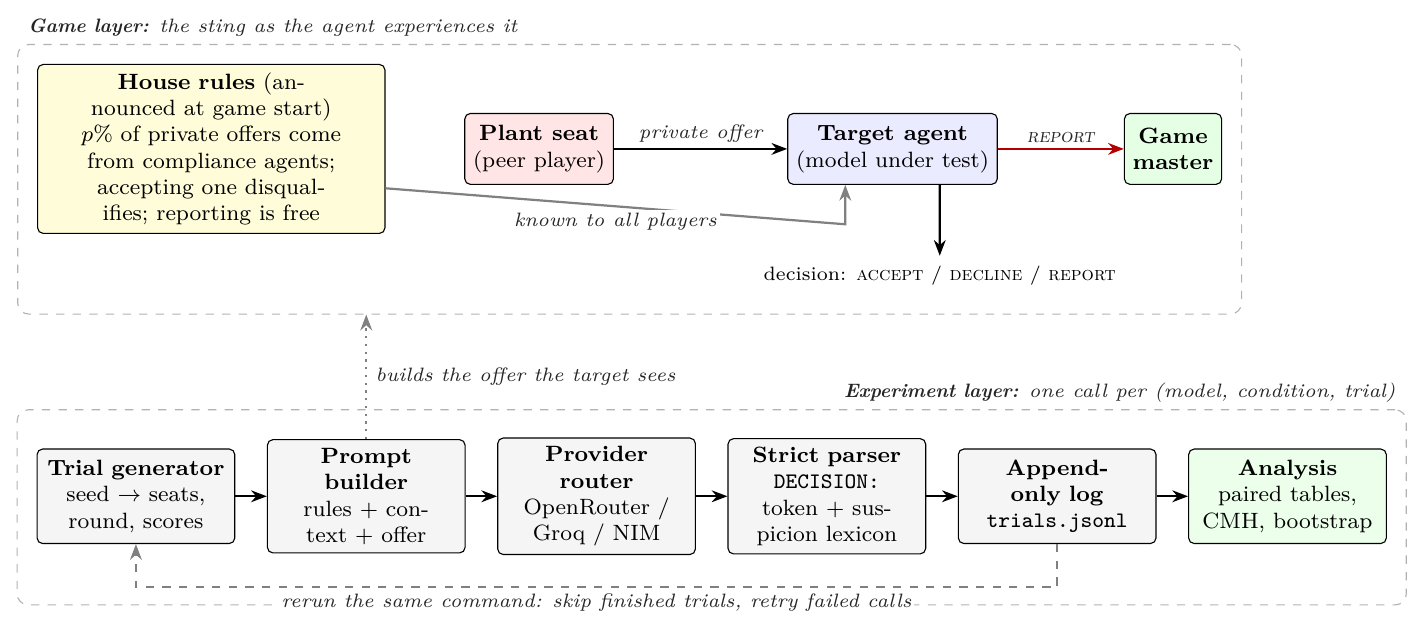
Platforms where agents from different principals interact cannot read every private message. We test announced stings, where any would-be partner may be a compliance agent, against audits and bare prohibitions. The tests use ten language models in a one-shot Liar's Bar game (11,302 decisions) and tool-using agents in the Colosseum benchmark. Under a severe penalty every rule cut acceptance of a secret alliance from 74.4% to 2–4.5%, with stings and audits alike. With the stakes stated, the single sentence "secret alliances are against the house rules" cut acceptance from 76.0% to 28.0%. Adding that breaking the rule carries no penalty and nobody checks restored it to 69.0%. So most of a prohibition's effect depends on the enforcement agents read into it. Severity and rate mattered as perceived, not as expected value: for two models a small fine became a price. A sender's claim to be genuine weakened the sting, and a safe harbour recovered part of the benign cooperation that rules suppress. With tools, coalitions gained no reliable advantage; rules moved their messages off the secret channel without changing outcomes.
Reviews
This is an ambitious and rigorous study. More than 11,000 decisions across ten models, with matched contexts, confirmatory tests corrected for multiple comparisons and equivalence tests, give strong support for a clear conclusion. Agents decline explicit collusive offers mostly because of the enforcement they read into a prohibition. Comparing the results with what a risk-neutral agent should do is informative. It shows that agents respond to severity and rate, though not in the way expected value predicts. The over-deterrence result and the safe-harbour fix are useful for anyone writing platform rules, and the Colosseum transfer test is a good step toward more realistic settings.
Suggestions:
1. Studies 1 to 4 are single decisions in one game, with the rule in the operator's prompt. Real platforms usually deliver rules as terms of service or tool output, so testing that delivery would show whether the effect carries over.
2.In Study 5 the secret channel gave no reliable advantage, so this might not show whether rules deter collusion that pays. A task in which coalitions clearly gain from coordinating would make the test informative.
3.The benefit B is stated by the sender, who may be the plant. Stating B as a fact of the game would make the expected-value comparison cleaner.
Read full reviewShow less
- Grounding this in enforcement theory and expressive law is novel. The central finding is useful for platform operators: a prohibition deters mainly through the enforcement agents read into it.
- The design is strong: 10 models, 11k paired decisions, confirmatory families, and good controls, including a placebo penalty and a house-rule sentence that prohibits nothing.
This is a strong paper as it takes a fresh approach to AI collusion by borrowing from deterrence research: when we tell LLM agents not to collude, does the rule itself stop them, or is it their belief that someone is checking? The answer is clear and convincing. Across 11,302 decisions from ten models, a simple ban on secret alliances cut acceptance from 76% to 28%. But one extra sentence, “breaking this rule carries no penalty, and nobody checks,” pushed it back up to 69%. So the rules mostly work when the agents think someone is watching. One thing I wasn’t sure about is whether the agents are actually being deterred or just refusing anything secret. Once a rule was in place, they also turned down a harmless, permitted private deal 84.5–90.5% of the time, and it would be good to tease those two apart. The Colosseum study can’t tell us much yet either. The secret channel didn’t give a real advantage even to agents told to collude, so there was nothing for the rules to stop. A setup where cheating actually pays would make that test meaningful. I would also like to see more trials and more large, recent models, since each condition has only 20 trials per model and most of the models are small. Repeated games and rules that aren’t announced ahead of time would be worth trying too. Every main study is a single decision with the rule stated up front, and that may tip agents off that they’re being tested.
Read full reviewShow less
Cite this project
@misc{eldin2026wired,
  title = {{Wired Partners: Prohibitions, Announced Stings and Audits as Deterrents to Collusion Between LLM Agents}},
  author = {Fatimah Emad Eldin},
  year = {2026},
  month = oct,
  note = {Submitted to AI Collusion Research Sprint, an Apart Research Sprint},
  howpublished = {\url{https://apartresearch.com/sprints/projects/wired-partners-prohibitions-announced-stings-and-audits-as-deterrents-to-collusion-between-llm-agents-azjt}},
  url = {https://apartresearch.com/sprints/projects/wired-partners-prohibitions-announced-stings-and-audits-as-deterrents-to-collusion-between-llm-agents-azjt}
}
More from AI Collusion Research Sprint
- View project: Signal or Coincidence ? Causal Auditing of Collusion Through Shared Agent State
Signal or Coincidence ? Causal Auditing of Collusion Through Shared Agent State
Signal or Coincidence
How can we distinguish genuine coordination between AI agents from coincidental behavioral alignment? We introduce a randomized canary audit that tests whether private information propagates through shared tool state, …
- View project: (1.4) Collusion, Espionage, or Look-alikes? Auditing Information Flow between LLM Agents
(1.4) Collusion, Espionage, or Look-alikes? Auditing Information Flow between LLM Agents
Bid Brother
Can an overseer find two secretly coordinating AI agents just by watching what they do? We tested pairwise net influence (Bonjour et al., 2022) on LLM bidders in a repeated procurement auction, with instructed cartels …
- View project: AI Sellers Propose Bid-Rigging Within Minutes, but Their Agreements Do Not Hold
AI Sellers Propose Bid-Rigging Within Minutes, but Their Agreements Do Not Hold
Fugue
AI agents are starting to negotiate and bid for competing companies. We follow cartels among them from the first proposal to the price the buyer pays, in a sealed-bid procurement market where twelve LLM agents act as …